


Quick answer: Use climb milling as the normal starting point on a rigid CNC machine because it reduces rubbing, improves surface finish, and can extend tool life. Use conventional milling when backlash, hard scale, uneven flame-cut stock, or an unstable setup makes climb milling too aggressive.
Climb milling and conventional milling describe the relationship between cutter rotation and feed direction in peripheral milling. In climb milling, the cutting edge enters at maximum chip thickness and exits at nearly zero. In conventional milling, the edge starts by rubbing at near-zero chip thickness and then grows into the cut.
Why climb milling is usually preferred on CNC machines
On a stable CNC machine, climb milling often gives the cleaner result because the edge cuts instead of sliding before it cuts. Less rubbing means less heat, less work hardening, and less tendency to tear the surface. For finishing passes, this is why climb milling is normally the first method to test.
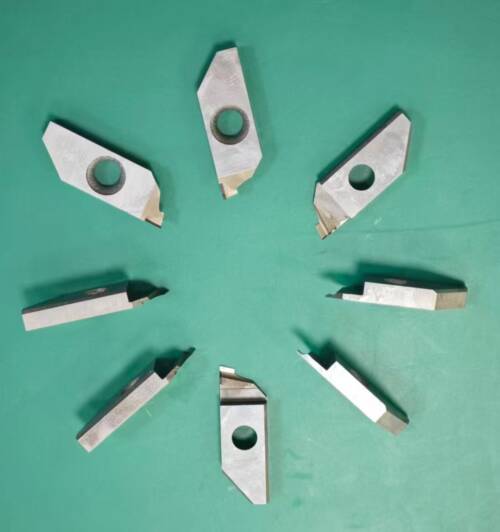
Climb milling also tends to push the workpiece down into the fixture when the setup is correct. That can be helpful for thin plates, precision shoulders, and finish-sensitive profiles. For aluminum and other non-ferrous work, the combination of the right cutting direction and a sharp tool such as a suitable PCD milling tool can be important for controlling built-up edge and surface marks.
When conventional milling is still useful
Conventional milling is not obsolete. It can be safer when the machine has backlash or when the workpiece surface is uneven. Flame-cut, laser-cut, cast, or scaled material may have a hard skin. In that situation, entering the cut more gradually can protect the edge during roughing.
A common shop-floor example is roughing a part from irregular stock, then finishing with climb milling after the hard outer layer and uneven allowance have been removed. That split is often more stable than trying to force one milling direction through every stage.
Practical selection checklist
- Machine condition: If backlash is controlled, climb milling is usually safer for CNC finishing.
- Workpiece surface: Use caution with climb milling on hard skin, casting scale, or rough flame-cut edges.
- Fixture rigidity: If the part can move, the milling direction may pull it into the cutter and cause a sudden bite.
- Tool geometry: Sharp positive tools cut freely, while stronger negative or heavier tools may need more machine power.
- Operation type: Roughing and finishing may need different directions, depths, and radial engagements.
What to send for tool review
If the issue is poor finish, chatter, or corner marks, send the material, cutter diameter, insert or end mill type, axial depth, radial width, feed, spindle speed, and fixture method. HEYI can review whether the problem points to the cutting direction, the carbide tool, the insert geometry, or the toolholder and setup.
When the part is expensive, do not treat climb versus conventional milling as a habit. Treat it as a process choice and confirm it with the actual machine, stock condition, and finish requirement. For a drawing-based review, use the HEYI RFQ form.