


Quick answer: Start turning insert selection by choosing between a positive and a negative style. Negative inserts usually provide stronger cutting edges and more usable edges when the setup is rigid. Positive inserts reduce cutting force and are often better for light machines, slender parts, boring bars, and thin-wall workpieces.
This first choice affects everything that follows: chip control, vibration, tool pressure, roughing capacity, and the practical cost per edge. In practice, the right answer depends less on the insert catalogue page and more on the machine, holder, workpiece rigidity, material, depth of cut, and whether the operation is roughing or finishing.
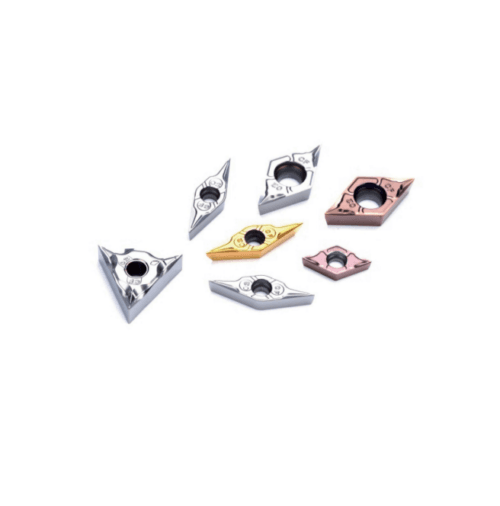
What positive and negative mean in turning inserts
Positive and negative inserts are commonly discussed through rake angle and insert geometry. A more positive rake cuts with a sharper, freer-cutting action. It can reduce cutting resistance, but the edge is usually less robust. A negative style supports the edge more strongly, but it needs more machine power and a more stable setup.
A simple visual check helps. Many negative inserts are double-sided and look symmetrical from the side. Positive inserts are usually single-sided, with clearance built into the insert shape. There are exceptions, so the insert code and holder style should still be checked before ordering.
Positive vs negative turning inserts
| Selection point | Positive insert | Negative insert |
|---|---|---|
| Cutting force | Lower, useful for light cuts and less rigid setups | Higher, needs stronger clamping and machine rigidity |
| Edge strength | Sharper but less supported | Stronger, better for heavier or interrupted cuts |
| Typical operation | Finishing, boring, small parts, thin-wall components | Roughing, stable OD turning, heavier stock removal |
| Cost per edge | Often fewer usable edges | Often more usable edges if the insert is double-sided |
Choose a negative insert when rigidity and edge security matter
A negative insert is usually the safer first review for stable roughing, larger depths of cut, forged or cast skin, interrupted cuts, and strong OD turning setups. The thicker supported edge can tolerate more load, and double-sided designs can improve cost per cutting edge.
That said, a negative insert is not automatically better. If the machine is small, the holder overhang is long, or the part is thin and easy to deflect, the extra cutting pressure can create chatter or dimensional instability. In those cases, edge strength alone does not solve the process.
Choose a positive insert when low cutting force matters
A positive insert is often used for small-diameter parts, slender shafts, internal turning, boring bars, thin-wall components, and finishing cuts where the part cannot tolerate high tool pressure. The sharper edge helps the insert cut instead of push.
This is why positive geometry is common in Swiss-type turning, small bores, and delicate finishing. The limitation is edge security. If the cut is heavy or interrupted, the sharper edge can chip faster than a stronger negative style.
Do not choose by insert shape alone
Insert geometry, chipbreaker, nose radius, grade, coating, holder approach angle, coolant, and cutting data all interact. For example, a larger nose radius can support higher feed and edge strength, but it can also increase radial force. A wiper insert can improve surface finish in a stable setup, but it is not a universal fix for vibration or long overhang.
RFQ checklist for turning insert selection
- Material and hardness: Include grade, heat treatment, and whether the surface is interrupted or scaled.
- Operation: State OD turning, ID turning, facing, profiling, roughing, semi-finishing, or finishing.
- Setup rigidity: Note holder size, overhang, part diameter, wall thickness, and clamping method.
- Current problem: Send photos of chipping, flank wear, chatter marks, poor chip control, or surface scratches.
- Target result: Share tolerance, surface finish, cycle-time limits, and whether tool cost or process security is the priority.
HEYI can review turning inserts, carbide tooling, CBN options, and custom requirements when a standard insert is not stable enough. Use the RFQ form to send the drawing, material, machine details, and current insert code.