


Quick answer: choose WNMU0806 when the machine and cutter body can support a stronger negative-style insert and the job needs economical roughing. Choose APMT1604 when lower cutting force, ramping, helical interpolation, or thin-wall stability matters more.
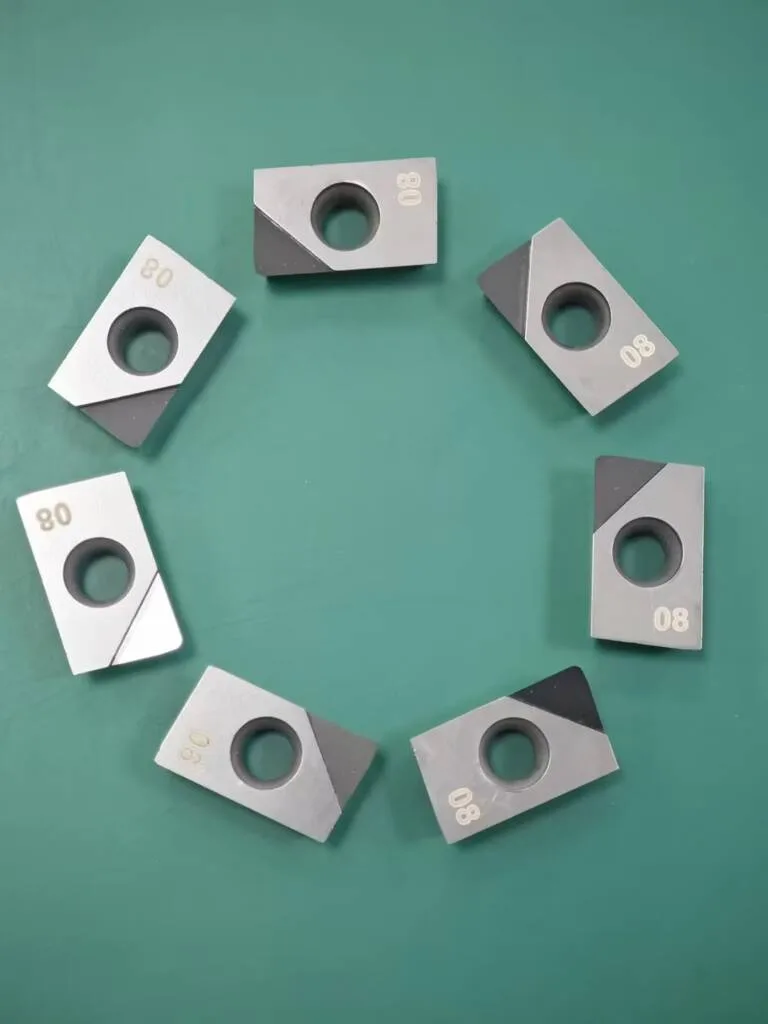
What is the main difference between WNMU0806 and APMT1604?
WNMU0806 is commonly used as a double-sided shoulder milling insert with more usable cutting edges. It is a good fit for stable machines and heavier cuts, but it generally asks for more spindle power and rigidity. APMT1604 is a positive-style single-sided insert. It usually cuts with lower resistance, which helps smaller machining centers, thin-wall parts, and interrupted setups where cutting force must stay controlled.
Selection table
| Condition | Safer starting choice | Why |
|---|---|---|
| Rigid machine, stable cutter body, roughing steel | WNMU0806 | Stronger edge support and better edge economy can be useful. |
| Small machine or limited spindle power | APMT1604 | Lower cutting force reduces load on the machine. |
| Helical interpolation, ramping, or pocket entry | APMT1604 | Positive clearance is usually safer for these tool paths. |
| Thin-wall or vibration-prone workpiece | APMT1604 | A sharper, lower-force cut helps reduce deflection. |
| Heavy shoulder milling with a strong setup | WNMU0806 | The insert can be more economical when the cutter body and machine are suitable. |
Why does machine rigidity matter so much?
Insert geometry changes cutting force, power demand, heat, and surface finish. Positive geometries tend to reduce cutting force and heat, but they give up some edge strength. Negative or stronger geometries can tolerate tougher cutting, but they push more load into the spindle, holder, cutter body, and workpiece. If one part of the setup is weak, the stronger insert may not produce the better result.
Do not judge only by the insert price
A double-sided insert can look more economical because it offers more edges, but the cutter body has to locate every insert accurately. Poor insert seating, radial runout, or uneven insert height can make even a good insert leave marks, overload one edge, or break prematurely. For face and shoulder milling, the holder, cutter body, screw condition, and insert pocket quality matter as much as the insert grade.
What should you send for a tooling review?
For a practical recommendation, send the machine model, cutter diameter, number of teeth, material, hardness, depth of cut, radial width, tool path, current insert, and failure mode through Full RFQ. If the issue is part deflection or tool marks, add photos of the surface and fixture. You can also start from Contact Us for a quick application discussion.
Related reading: heavy machining applications and custom tooling.