


Quick answer: Choose hole machining tools by material, hardness, chip shape, and hole type. A carbide drill that works well in stainless steel may not be the best choice for hardened tool steel, cast iron, or aluminum. The same rule applies to taps and thread mills.
Hole machining is less forgiving than open milling because chips, coolant, runout, and cutting heat are all trapped inside a confined space. In practice, a good selection starts with the workpiece material and then checks the hole depth, blind or through-hole condition, tolerance, surface finish, and thread requirement.
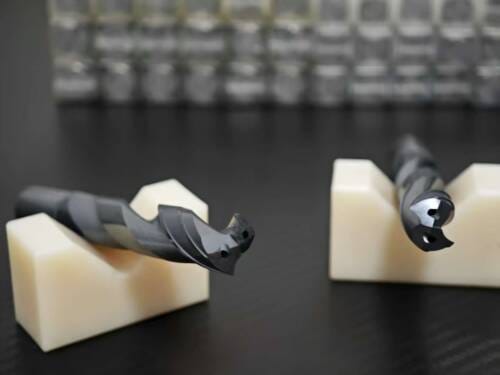
Hardened tool steel and high-hardness alloy steel
For hardened tool steel, such as die steel after heat treatment, drilling usually needs a rigid setup, short overhang, accurate runout control, and a suitable carbide drill. If internal threads are required in high hardness, tapping may become risky because torque rises and chip evacuation becomes less forgiving.
That said, hardness is not the only factor. Surface scale, interrupted entry, hole depth, and coolant access can change the route. For hard materials or expensive parts, thread milling is often worth reviewing because it can reduce the risk of a broken tap being trapped in the part.
Ductile cast iron and gray cast iron
Cast iron often produces short, powdery or granular chips. That can make drilling and tapping more stable than in gummy materials, but abrasive wear can still be high. The tool material, coating, coolant or air blast, and machine sealing should match the casting condition.
For ductile cast iron, carbide drills and suitable taps can work well when the hardness and graphite structure are understood. For higher volume or tighter hole quality, a reaming or finish-boring step may be needed after drilling.
Stainless steel: chip control before tool life claims
Austenitic stainless steels such as 304 and 316 are tough, sticky, and prone to work hardening. The drill should cut cleanly instead of rubbing, and chip evacuation should be controlled before increasing speed. Through-coolant carbide drilling is often reviewed when the machine supports it, especially for deeper holes.
For tapping, the hole type matters. Spiral flute taps are commonly used for blind holes because they pull chips back, while spiral point taps are often used for through holes because chips can be pushed forward. If the material is ductile enough and thread form requirements allow it, forming taps may also be reviewed.
Carburizing steels and alloy steels such as 20Cr, SCr420, and 40CrMo
Alloy steels should be separated by actual hardness and heat treatment. A material in annealed or normalized condition behaves very differently from a quenched and tempered part. For CNC production, through-coolant carbide drills and material-matched taps are common starting points. For harder conditions, thread mills or special tooling may be safer.
Aluminum, copper, and other non-ferrous materials
Non-ferrous materials need sharp cutting edges, good chip evacuation, and attention to built-up edge. In aluminum, polished carbide drills and end mills are common; in high-volume or finish-sensitive non-ferrous machining, PCD tools may be reviewed. In copper and brass, chip shape and burr control often decide whether the route needs a standard tap, forming tap, or custom tool geometry.
Selection checklist before sending an RFQ
- Material and hardness: Include the grade and actual hardness, not only the trade name.
- Hole condition: State diameter, depth, blind or through hole, entry angle, and tolerance.
- Thread data: Include thread size, pitch, thread depth, and gauge requirement.
- Machine condition: Note spindle type, coolant pressure, runout, holder type, and rigidity.
- Failure mode: Send photos of chips, worn cutting edges, burrs, broken taps, or poor finish.
HEYI can review carbide tools, custom tooling, and process details when a standard drill or tap is not stable enough. Use the RFQ form to attach drawings, material data, and current cutting parameters.