


Quick answer: Do not change a turning insert only because it “does not last.” First identify the wear pattern. Chipping, flank wear, crater wear, built-up edge, notch wear, and heat damage point to different causes, so they need different corrections.
A turning insert usually fails in one of two broad ways: the edge breaks, or the edge wears. Chipping and fracture are mechanical failures. Flank wear, crater wear, built-up edge, and plastic deformation are wear or heat-related failures. In practice, the right solution may be a stronger geometry, a tougher grade, a sharper edge, lower cutting speed, better coolant aim, or a different depth-of-cut strategy.
Start by reading the edge, not the catalog
If small pieces are missing from the cutting edge, the insert is seeing impact, vibration, hard inclusions, interrupted cutting, or too much load at entry and exit. A tougher grade, stronger edge preparation, larger included angle, shorter overhang, or more stable clamping may help.
If the wear land is smooth and even along the flank, the process may simply be reaching normal tool wear. When flank wear grows too quickly, cutting speed, workpiece abrasiveness, coolant direction, and grade choice should be reviewed before assuming the insert is defective.
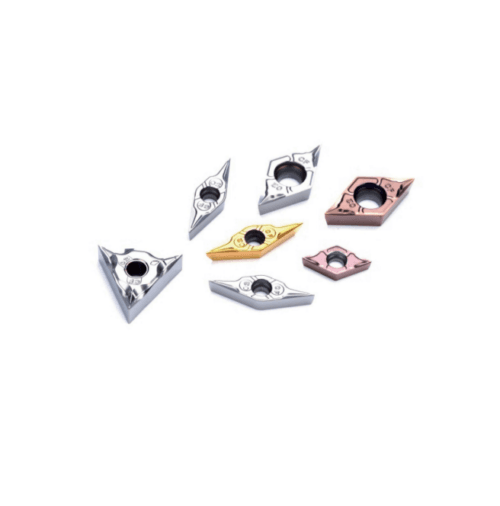
Common turning insert wear patterns
- Flank wear: Usually predictable. If it grows too fast, review cutting speed, grade wear resistance, and coolant application.
- Chipping: Often tied to vibration, interrupted cuts, hard spots, weak clamping, or an edge that is too sharp for the load.
- Crater wear: Appears on the rake face where chips slide across the insert. Heat and abrasive chip contact are common causes.
- Built-up edge: Workpiece material sticks to the edge, often in gummy materials or low-speed cutting, and can tear away coating or edge material.
- Plastic deformation: The edge changes shape under high heat and force. This points to thermal overload, excessive cutting data, or insufficient hot hardness.
- Notch wear: Localized damage at the depth-of-cut line, often seen with work-hardened or scaled surfaces.
How speed, feed, and depth of cut change the diagnosis
Cutting speed strongly affects heat. If the edge is overheating, crater wear or deformation may appear before the insert reaches predictable flank wear. Feed and depth of cut affect mechanical load and chip formation. A feed that is too light may rub and form built-up edge; a feed that is too heavy can break the edge, especially in interrupted cuts.
That said, there is no universal “safe” number. Steel, stainless steel, cast iron, hardened steel, and superalloys all load the edge differently. The useful starting point is the insert grade, geometry, nose radius, holder rigidity, coolant condition, and the actual wear mark after the first trial.
Geometry choice: stronger edge or lower cutting force?
A stronger edge can tolerate higher load, but it normally generates more cutting force and heat. A sharper, more positive geometry lowers cutting force and can improve finish on slender or unstable parts, but it may chip faster in heavy roughing or interrupted cuts.
For small Swiss-type parts, fine finishing, and thin features, a free-cutting turning insert can reduce deflection. For tougher roughing, interrupted cuts, hardened steel, or abrasive materials, HEYI may review carbide tools, CBN tools, or a custom edge preparation depending on hardness and surface condition.
What to send for a turning insert review
For an RFQ or troubleshooting request, send the insert shape and grade, workpiece material and hardness, operation type, cutting speed, feed, depth of cut, coolant method, holder overhang, and a clear photo of the worn edge. A photo often tells more than a long description. Use the HEYI RFQ form when the problem involves repeated chipping, unstable finish, or an expensive workpiece.