


Quick answer: Custom cutting tools make sense when a standard catalog tool cannot match the machine, material, reach, coolant, coating, thread depth, or hole condition. The goal is not to make a tool special for its own sake; it is to remove a clear process constraint.
A standard tool should always be checked first when it can do the job safely. Custom tooling becomes practical when the cost of instability, scrap, slow cycle time, tool breakage, or repeated hand modification is higher than the cost of designing the right tool.
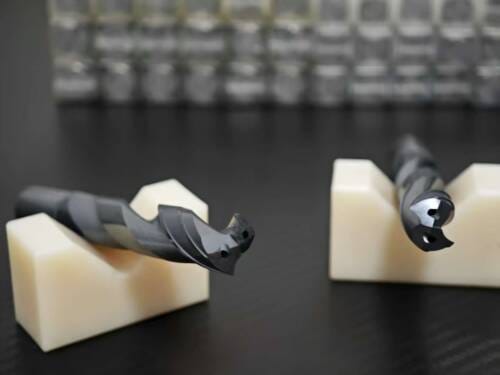
Custom tools should start from a specific problem
A useful custom-tool request is concrete. It does not simply say “make a better drill” or “make the tap stronger.” It says what the current tool cannot do: the machine has no through-coolant, the hole is too deep for chip evacuation, the aluminum builds up on the cutting edge, or a tap chamfer cannot reach the required full thread depth.
In practice, the best custom tools are usually simple adaptations of proven tool families: a different coolant route, a modified flute, a shorter chamfer, a special coating, a non-standard diameter, or a geometry matched to one material.
Example 1: the machine has no through-coolant
Through-coolant drills are common for production holemaking, but they only help when the machine and holder can deliver coolant correctly. If a machine has no center-through coolant, buying a through-coolant drill may not solve chip evacuation or edge cooling.
For a 6.0 mm drilling job on a machine without through-coolant, the review may point toward a non-through-coolant carbide drill, an external coolant strategy, a revised pecking cycle, or a custom geometry. The right answer depends on hole depth, material, tolerance, and production volume.
Example 2: ADC12 aluminum needs coating and edge geometry review
ADC12 aluminum alloy is often machined with sharp carbide tools, but built-up edge, burrs, chip welding, and finish problems can still appear. If the job is high volume, a material-specific coating or geometry may be worth reviewing.
DLC coating, polished flutes, sharper edge preparation, or PCD tooling may be considered for non-ferrous production. That said, the coating alone is not the whole solution. Chip evacuation, cutting speed, coolant or mist, holder runout, and toolpath also matter.
Example 3: a tap cannot reach full thread depth
A blind-hole thread can fail even when the tap material is correct. If the lead chamfer is too long, the tap may not produce full threads close enough to the bottom. Grinding the tap by hand may weaken it or make the result inconsistent.
For an unusual thread such as 1/4-40 in 304 stainless steel, a shorter chamfer, revised pilot hole, different flute style, or thread-milling route may be reviewed. The custom part of the tool should match the real constraint: thread reach, chip evacuation, torque, or gauge requirement.
When a standard tool is still the better choice
| Condition | Likely route |
|---|---|
| Short run, loose tolerance, stable process | Use a standard tool and optimize cutting data first |
| Repeat production with a known failure mode | Review custom geometry, coating, coolant, or reach |
| Expensive part where tool breakage causes scrap | Review process security and fallback routes before production |
| Special thread or hole depth close to the bottom | Review custom taps, thread mills, or modified pilot-hole strategy |
What data makes a custom tool review faster?
- Drawing and feature detail: Diameter, depth, tolerance, thread size, bottom clearance, and surface finish.
- Material: Grade, hardness, heat treatment, casting or forging condition, and coating if present.
- Machine limits: Spindle, holder, coolant pressure, through-coolant availability, and maximum tool length.
- Current tool: Brand or geometry type, coating, flute count, cutting data, and failure mode.
- Production goal: Batch size, cycle-time pressure, tool-change limits, and whether regrinding is planned.
HEYI can review custom tooling, carbide drill options, PCD tooling for non-ferrous materials, and process changes. Use the RFQ form to send the drawing, material, machine details, and photos of the current tool problem.